Sieve Analysis Lab Report
7 Fine AggregateThe size of the test sample after drying shall be 300 g minimum. To the anniversary page.

Sieve Analysis Lab Report The Oscillation Band
Kitch Angelo State University Direct Shear Test Triaxial Compression Test in Rock What is.

. Abstract In this experiment a tensile test is carried out on a mild steel sample. Understanding your Turf Irrigation Water Analysis Report WT01 Understanding your Turf Irrigation Water Analysis Report WT02 Pond and. The ordinary direct plot is dismissed as unsuited for sizing-diagrams.
Mass retained on No. Any mechanical sieve-shaking device that accomplishes the same thoroughness of sieving as the hand-sieving procedure described in F1a of this method. Mass retained on No.
10 sieve 395 g. Assume that the soil was previously passed though a No. Sieving- Ed Ryan Ruales.
We conduct a sample grinding particle or sieving analysis and recommend the right instrument for your application. Report percent loss in weight as moisture. For the No4 sieve.
It is usually performed for sand and gravel but cannot be used as the sole method for determining the grain size distribution of finer soil. The lab offers comprehensive analyses of soil water plant tissue manure compost and other agricultural materials. What size are those particles.
Similar to Sieve analysis of coarse and fine aggregate - Report. Thoroughly mix the soil with a small amount of distilled water until it appears as a smooth uniform paste. Banging the sieve on the floor or hitting the sieve with a hammer will damage the sieve.
Individual sample grinding sieve and particle analysis. Sieve Analysis Lab Report Discussion Conclusion. Equipment for Preparing Specimens Laboratory Testing Water Content w Atterberg Limits Unconfined Compression Test Soil Consolidation and Oedometer Test Step-by-Step Guide for Grain Size Analysis Geotechnical Engineering Lab Manual by Prof.
The sieve analysis determines the gradation the distribution of aggregate particles by size within a given sample in order to determine compliance. Your partner in the lab. Grind the sample in a grinder to pass through No.
For other crops plant tissue analysis in combination with soil test information is the recommended approach for diagnosing nutrient deficiencies and determining fertilizer requirements. Send us your sample. Sphere and report the value of some equivalent diameter.
The final total of the weights retained on each sieve should be within 03 of the original weight of the sample prior to grading. Microscopy or automated image analysis are the only techniques that can describe particle size using multiple values for particles with larger aspect ratios. The cumulative direct plot is simple and fulfills most of the requirements tolerably well but it does not permit the representation of the entire.
Is a basic essential test for all aggregate technicians. The results are used to determine compliance of the particle size distribution with applicable specification requirements. Store sample in a tightly stoppered bottle.
4 sieve 97 g. Arrange the IS sieve in descending 25mm20mm 125mm 10mm 475mm. Mix well to get a homogenous sample.
Total mass 500 g. After completion of sieving then weigh the aggregates retained in each sieve note it down. Soil test may refer to one or more of a wide variety of soil analysis conducted for one of several possible reasons.
Possibly the most widely conducted soil tests are those done to estimate the plant-available concentrations of plant nutrients in order to determine fertilizer recommendations in agricultureOther soil tests may be done for engineering geotechnical geochemical or. This website uses cookies to help provide you with the best possible online experience. Use the template provided to prepare your lab report for this.
The 100-year success story. Plant tissue analysis is a valuable aid in crop management. Four methods of plotting sizing-tests have been described in this paper.
Particle Size and Sand Sieve Test Environmental Soil Testing Aluminum Stress Test. Cover the dish with cellophane to prevent moisture from escaping. Replace any damaged or nonconforming sieves.
Please read our Terms Conditions and Privacy Policy for information about. NOTE4Where sieve analysis including determination of material finer than the 75-μm sieve is the only testing proposed the size of the sample may be reduced in the field to avoid shipping excessive quantities of extra material to the laboratory. 3 Calculate the percent passing or percent finer by starting with 100 percent and subtracting the percent retained on each sieve as a cumulative procedure.
Particle technology lab report nabeel sultan. - AOAC 17th edn 2000 Official Method 96811 Moisture Loss on. 2 Performing a particle size analysis is the best way to answer the question.
Alone it can be used for making fertilizer recommendations for certain crops such as tree fruits and grapes. The sieve openings by gently working from either or both sides with a trowel or piece of flat metal until the aggregate is freed. 40 sieve air-dried and then pulverized.
MANUAL 4 MANUAL OF METHODS OF ANALYSIS OF FOODS. Objectives To study the behaviour of materials under tensile load and to obtain primary parameter values of materials such as. Retained on each sieve by the original sample mass.
This experiment is conducted to study the behaviour of. Now fill the sample to the highest sieve and sieve well for up to 10 minutes. Yield strength ultimate tensile strength Youngs modulus and ductility.
Sieve analysis is a method that is used to determine the grain size distribution of soils that are greater than 0075 mm in diameter. Each sieve shall be inspected visually for bent or distorted wires after each use. This test method is used primarily to determine the grading of materials proposed for use as aggregates or being used as aggregates.
2 Weigh four of the empty moisture cans with their lids and record the.
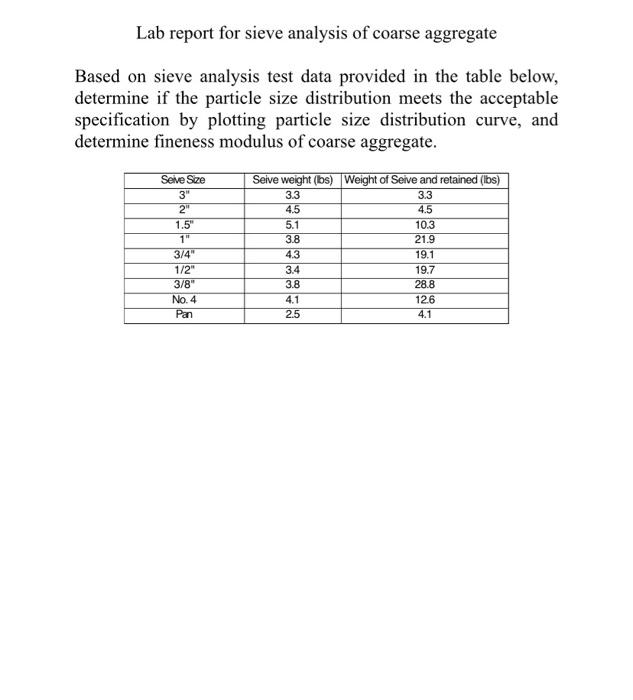
Solved Lab Report For Sieve Analysis Of Coarse Aggregate Chegg Com
Project Report On Concrete Mix Design Of Grade M35
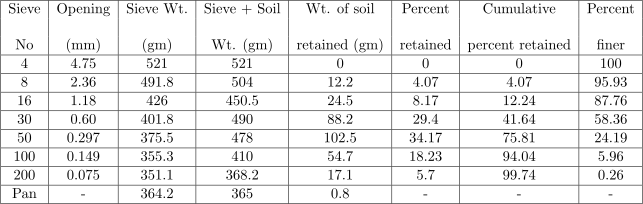
Sieve Analysis Properties And Behavior Of Soil Online Lab Manual
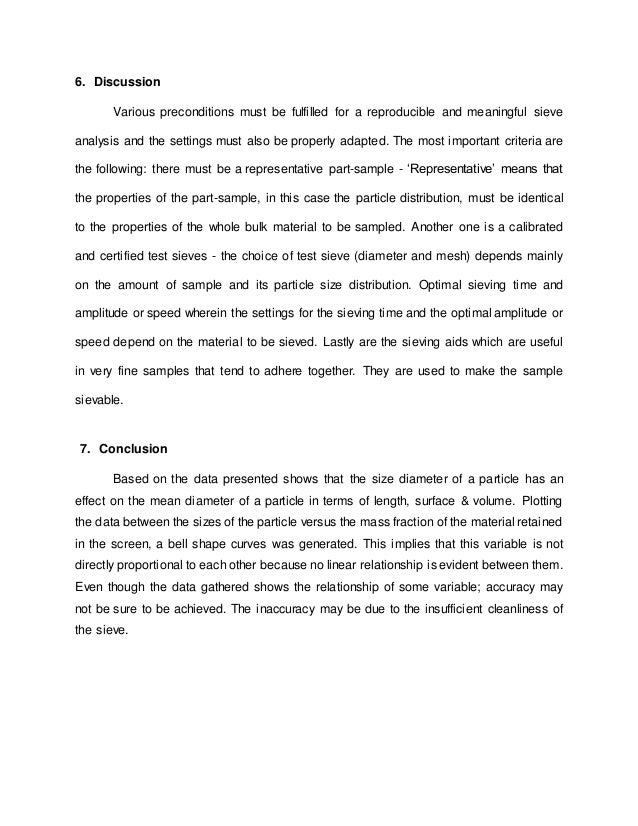
Sieving Final Report
No comments for "Sieve Analysis Lab Report"
Post a Comment